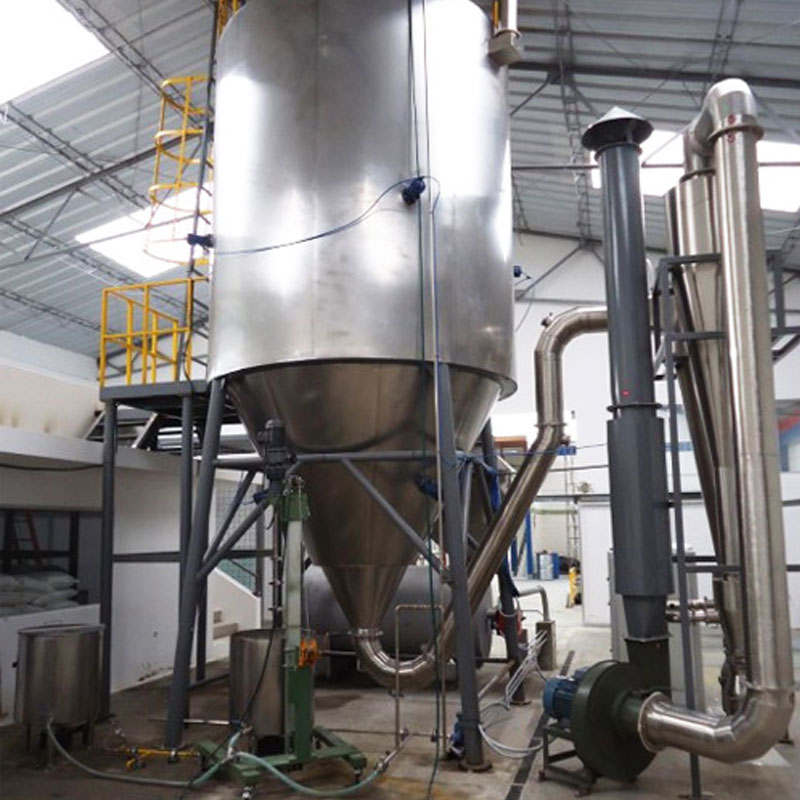







Design and Control of Spray Dryer
 Jun 04, 2024|
 View:1797
The challenges facing both designers and users are to increase production, improve powder quality and reduce costs. This requires an understanding of the process and a robust control implementation.
Spray drying consists of the following phases:
Feed preparation: This can be a homogenous, pumpable and free from impurities solution, suspension or paste.
Atomization (transforming the feed into droplets): Most critical step in the process. The degree of atomization controls the drying rate and therefore the dryer size. The most commonly used atomization techniques are:
1. Pressure nozzle atomization: Spray created by forcing the fluid through an orifice. This is an energy efficient method which also offers the narrowest particle size distribution.
2. Two-fluid nozzle atomization: Spray created by mixing the feed with a compressed gas. Least energy efficient method. Useful for making extremely fine particles.
3. Centrifugal atomization: Spray created by passing the feed through or across a rotating disk. Most resistant to wear and can generally be run for longer periods of time.
Drying: A constant rate phase ensures moisture evaporates rapidly from the surface of the particle. This is followed by a falling rate period where the drying is controlled by diffusion of water to the surface of the particle.
Separation of powder from moist gas: To be carried out in an economical (e.g. recycling the drying medium) and pollutant-free manner. Fine particles are generally removed with cyclones, bag filters, precipitators or scrubbers.
Cooling and packaging.
A control system must therefore provide flexibility in the way in which accurate and repeatable control of the spray drying is achieved and will include the following features:
Precise loop control with setpoint profile programming
Recipe Management System for easy parameterisation
Sequential control for complex control strategies
Secure collection of on-line data from the system for analysis and evidence